

The Best Non-Toxic Multi-Surface Cleaner: A Buyer’s Guide
One spray, every surface, nothing to hide. Most “multi-surface” cleaners are mostly water, synthetic fragrance, and a label you’d rather not read. Here is the honest checklist for choosing a true multi-surface cleaner — what to look for, what to walk away from, and the cost math no roundup will show you.
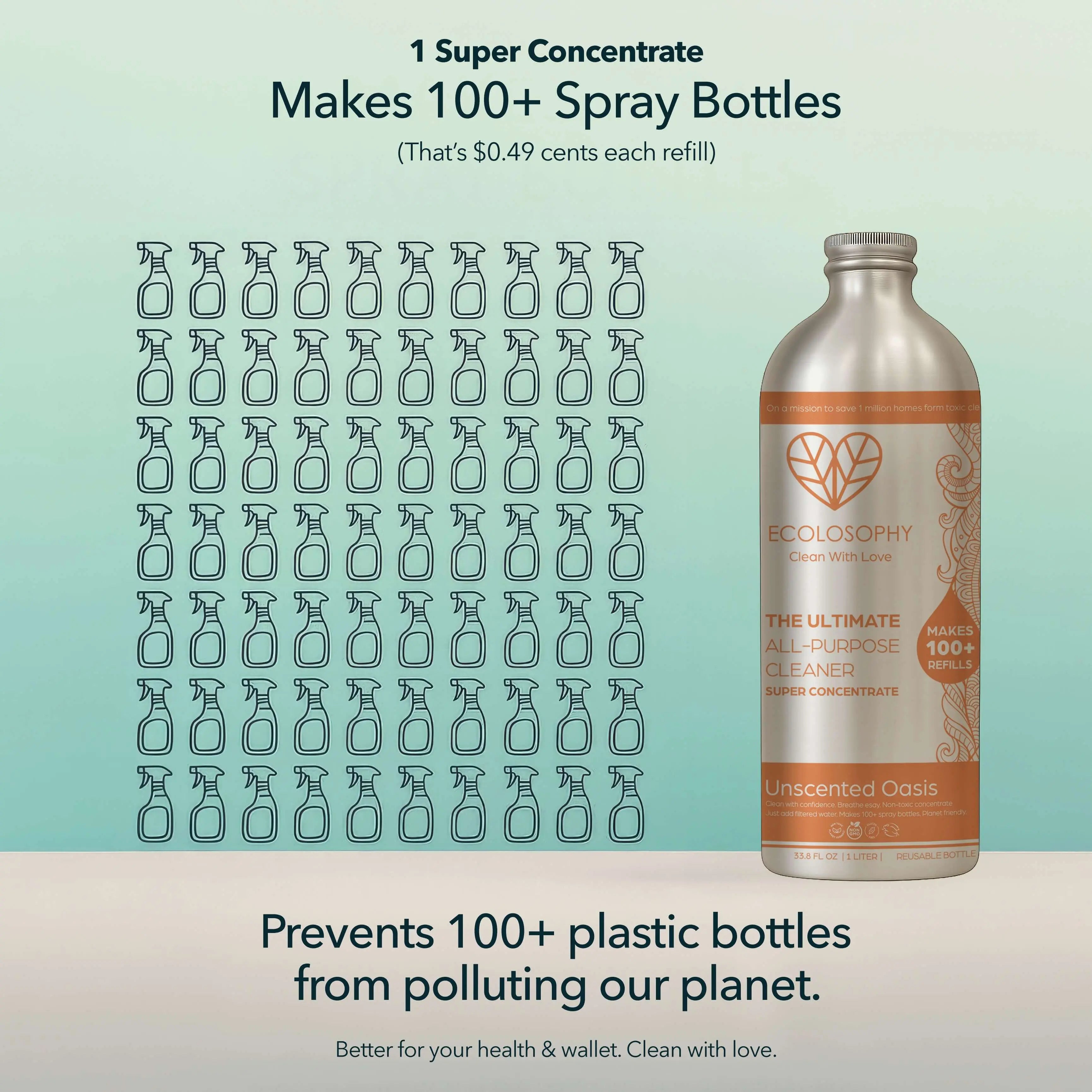
Short answer: The best non-toxic multi-surface cleaner is a plant-based concentrate with a full ingredient list, a fragrance-free option, and dilution control for counters, floors, and sealed finishes. Our pick is the Ecolosophy All-Purpose Cleaning Concentrate — small-batch, made with care. One bottle makes 100+ spray bottles.
What “multi-surface” should actually mean
The phrase “multi-surface” is on almost every spray bottle, but it’s rarely defined. A genuine multi-surface cleaner does one job extremely well: it lifts everyday dirt, grease, and grime off a wide range of materials — sealed countertops, tile and finished floors, glass, stainless steel, painted walls, and most plastics — without dulling finishes, leaving streaks, or demanding a different bottle for every room.
That sounds simple, but it’s where most products quietly fail. Some are degreasers dressed up as all-purpose sprays and are too harsh for delicate finishes. Others are so diluted they smear instead of clean. The best ones are built on plant-based surfactants — the molecules that actually grab grease and pull it off a surface — balanced so they rinse or dry clean. The perfume on the front of the bottle does none of the cleaning. It’s marketing.
Here is the inconvenient truth most brands won’t print: you spray these products in the air your family breathes, on the counters where you prep food, and on the floors where babies crawl and pets nap. So the bar for a multi-surface cleaner shouldn’t just be “does it clean?” It should be “does it clean and is it something I’m comfortable living inside of every single day?” Those are two different questions, and the second one is the one that matters.
What to look for: the buyer’s checklist
Forget the word “non-toxic” on the front — it’s unregulated and a brand can print it on almost anything. Judge the back of the bottle instead. A true non-toxic multi-surface cleaner should meet all five of these tests at once:
- Full ingredient transparency. Every ingredient is listed in plain language. If you can’t see what’s inside, assume the worst — the word “fragrance” is the most common hiding place.
- Plant-based chemistry. Surfactants derived from plants (coconut, olive) instead of harsh petroleum solvents, doing the actual cleaning work.
- A fragrance-free option. Scent is added for marketing, not performance. The best brands offer an unscented version for sensitive households, pregnancy, cats, and asthma.
- Concentrate value. A concentrate ships the cleaning power and lets you add water at home — instead of paying to ship plastic bottles full of water. One Ecolosophy bottle makes 100+ spray bottles.
- Honest claims. A cleaner is a cleaner. It removes dirt and most germs. It is not an EPA-registered disinfectant unless it explicitly says so — and a brand that’s honest about that distinction is one you can trust.
If a product fails even one of these — especially transparency — treat it as a question mark. The badge that matters most isn’t a logo. It’s a full, readable ingredient list. A brand that publishes what’s in everything has nothing to hide.
What to avoid
Generic advice stops at “bleach and ammonia.” The ingredients label-savvy parents actually search for go deeper. If you see any of these on a multi-surface cleaner, put it back:
- Synthetic “fragrance” / “parfum.” A single word that can legally hide dozens of undisclosed chemicals, sometimes including phthalates. Per EWG, no US law requires cleaning-product makers to list what’s inside “fragrance.”
- Quats (benzalkonium chloride and other “-onium chloride” compounds). Common in “antibacterial” sprays; recognised skin and respiratory irritants, and documented in occupational case reports as a cause of work-related asthma with repeated professional handling.
- Glycol ethers (2-butoxyethanol). A solvent in many glass and all-purpose sprays. ATSDR reports hemolysis in animal studies and reproductive effects at high animal doses, and states there are no human data on reproductive effects, birth defects or cancer.
- Chlorine bleach and ammonia. Respiratory irritants that release toxic gases if accidentally mixed. Never combine cleaning products.
- Synthetic dyes. Cosmetic coloring with zero cleaning function — pure additive risk.
- Vague labels. “Surfactants,” “preservatives,” or “cleaning agents” with no specifics. Missing information is itself a red flag.
The Ecolosophy All-Purpose Cleaning Concentrate contains none of these. It’s plant-based with no artificial scents — plant-based and fully disclosed — just add water.
How the formats compare
The single biggest factor separating multi-surface cleaners isn’t the brand — it’s the format. Here’s an honest, neutral read of the field on transparency, fragrance options, and cost-per-use:
| Format | What’s in the bottle | Fragrance-free option | Plastic footprint | Cost per finished bottle |
|---|---|---|---|---|
| Plant-based concentrate (e.g. Ecolosophy) | Cleaning power; you add water | Typically yes | One small bottle, reusable sprayer | Often under $0.50 |
| Conventional ready-to-spray | 90%+ water, often synthetic fragrance & dyes | Rare | A new bottle every time | Typically several dollars |
| Premium “natural” ready-to-spray | 90%+ water, plant-based but pre-mixed | Sometimes | A new bottle every time | Frequently higher still |
| DIY vinegar / castile soap | You mix it yourself | Yes | Reusable, but limited | Cheap, but weak on grease & risky on stone |
Ready-to-spray cleaners are mostly water. You’re paying to ship water in plastic, over and over. A concentrate ships the cleaning power and lets you add the water at home — which is exactly why it wins on both price and plastic.
The cost, plastic, and carbon math
Here’s the table the affiliate roundups won’t publish, because it’s devastating for a $49.95 concentrate that makes 100+ bottles:
| Metric | Ready-to-spray bottles | Ecolosophy Concentrate (1 bottle) |
|---|---|---|
| Bottles you buy | 100+ separate plastic bottles | 1 concentrate + reusable sprayer |
| Ready-to-use bottles produced | 1 per bottle | 100+ from one concentrate |
| What you’re paying to ship | Mostly water, in plastic | Cleaning power; you add water at home |
| Carbon | Shipping water in every bottle | ~42.75 lbs CO2 saved per bottle (our lifecycle estimate) |
| Kit price | Adds up over the year | $49.95–$65 kit, then refills |
One bottle, 100+ uses. That’s the difference between buying cleaning power once and buying shipped water on repeat.
Want the room-by-room version of this?
The free 7-Day Home Detox walks you through one room a day — what to toss, what to keep, what actually matters.
Cleaning vs. disinfecting: read this before you buy
This is the most confused point in home cleaning, and almost no one explains it plainly. Cleaning physically removes dirt, grime, grease, and most germs using surfactants and friction. Disinfecting kills a specified percentage of named pathogens, and only EPA-registered disinfectants can legally make that claim.
Be clear-eyed: a plant-based multi-surface concentrate like Ecolosophy is an exceptional cleaner, not a registered disinfectant. For the vast majority of daily messes — counters, floors, glass, high chairs, paw prints — thorough cleaning is exactly what you want, and physically removing germs is safer than blasting your home with a residue-leaving disinfectant every day. Reserve a registered disinfectant for genuine contamination events (raw meat, illness), used as labeled. Any honest brand will tell you the same.
How to verify any cleaner yourself
Here’s the radical-transparency move no affiliate list dares to make: we’ll teach you to check any product, including ours. Three tools do the heavy lifting:
- Yuka — scan the barcode for a hazard score and ingredient flags.
- EWG (Healthy Living) — look up ingredients and product ratings.
- Think Dirty — ingredient breakdowns and cleaner alternatives.
The most important skill: find the word “fragrance” or “parfum.” If a label uses it with no breakdown, treat it as a question mark. We invite you to scan Ecolosophy the same way you’d scan anything else.
Frequently asked questions
What makes a multi-surface cleaner truly non-toxic?
A genuinely non-toxic multi-surface cleaner publishes its full ingredient list, uses plant-based chemistry, offers a fragrance-free option, and skips synthetic fragrance, dyes, quats, and harsh solvents. “Non-toxic” is an unregulated word, so judge the back of the bottle, not the front. The Ecolosophy All-Purpose Cleaning Concentrate is plant-based with no artificial scents — plant-based and fully disclosed.
Can one cleaner really work on every surface?
Yes, for sealed everyday surfaces. A well-balanced plant-based concentrate safely cleans counters, finished floors, glass, stainless steel, painted walls, and most plastics. Always spot-test delicate or unsealed natural stone, and follow the label.
Is a fragrance-free cleaner less effective?
No. Scent is added for marketing, not cleaning power — the actual work is done by surfactants, not the perfume. A fragrance-free formula cuts everyday dirt, grease, and grime just as well, and it’s the safest choice for cat households, pregnancy, and sensitive airways.
Why is a concentrate cheaper than ready-to-spray?
Ready-to-spray cleaners are mostly water shipped in plastic. One Ecolosophy concentrate makes 100+ finished spray bottles — just add water — so you buy cleaning power once instead of shipped water on repeat, and you keep 100+ single-use bottles out of the trash.
Does a non-toxic multi-surface cleaner disinfect?
No. Cleaning removes dirt and most germs; only an EPA-registered disinfectant can claim to kill specific pathogens. A plant-based concentrate like Ecolosophy is a high-performance cleaner, not a registered disinfectant — which is exactly what you want for daily messes.
Is the Ecolosophy concentrate safe for kids and pets?
It is formulated to be family- and pet-safe: plant-based, with no artificial scents — plant-based and fully disclosed. As with any cleaner, store it sealed and out of reach, spray the cloth rather than the air, ventilate, and let surfaces dry before little ones and pets return.
📕 Free download · 28 pages
Not ready to switch yet? Get the free playbook.
28 pages, every non-toxic swap, room by room. One email, no spam.
We'll email it from hello@ecolosophy.com. Reply anytime — a real person answers.
Sent. Check your inbox.
The download link is heading to your email. If you don't see it in 2 minutes, look in Promotions or hit resend.
Or grab it right now: Download the 28-page PDF →
Couldn't deliver — try again? Retry
← Back to the full Non-Toxic Cleaning Guide
Keep Reading
Unscented Oasis Kit
$69 · 4.97★ · 72 reviews