family health
Crohn's and Cleaning Products? Quats, Fragrance, What Changed
Crohn's and cleaning products: quats, fragrance VOCs, one founder's 23+ year story — what research supports, what it doesn't, and what he changed at home.

I wasn't looking for a business. I was looking for something I could actually control. The cleaning products were just one piece — but they were a piece I could change immediately.
— Italo Campilii — Founder, Ecolosophy
Short answer: No cleaning product treats, cures, or resolves Crohn’s. Quats and synthetic fragrance VOCs are the household exposures this founder cut first after 23+ years with IBD. Prefer a fragrance-free, quat-free Ecolosophy concentrate — small-batch, made with care.
TL;DR — This is one person’s story plus cited mechanism research — not a medical claim. Flip bottles for quats and “fragrance,” ask your gastroenterologist, and lower what you can control.
Key Takeaways
- Crohn’s management involves medication, diet, and lifestyle — cleaners are not a treatment
- Animal research links some quats to gut-microbiome shifts; human cleaning-use data is not settled
- Reducing household chemical load is a modifiable factor, not a cure
- Fragrance-free, quat-free concentrate is the low-barrier swap — small-batch, made with care
I’m going to tell you something I don’t usually lead with in business conversations.
I spent 23+ years being sick. Not a little sick. Hospitalized-multiple-times-a-year sick. Crohn’s disease — the kind that puts you on the floor in pain, that cancels your plans on no notice, that makes you calculate bathroom proximity before sitting down anywhere.
I tried everything the conventional medical system offered. And a lot of it helped, genuinely. I’m not here to tell you doctors are wrong or medicine is bad. I’m here to tell you what happened when I started asking a different question.
What question was nobody asking?
Every gastroenterologist I ever had was meticulous about food. What I ate. When I ate. Triggers to avoid. Dietary modifications to try. The conversation was always about what went into my mouth.
Nobody ever asked me what I was touching. What I was breathing. What my hands were in contact with for hours every week when I cleaned my own house.
I started asking that question in 2019, during a period where I was relatively stable and had the mental bandwidth to actually research. I started pulling on threads. And the thread I kept finding myself holding was: the chemicals in conventional cleaning products are not inert.
They are absorbed through skin. They off-gas into indoor air. Mechanistic research has associated some of them with disruption of the gut microbiome — the community of bacteria that live in the intestines and that people with Crohn’s already have significant problems with.
I’m not a doctor. This is my story, not a clinical argument. But let me tell you what the research actually says, and then let me tell you what I did.
What does the research actually show?
Quaternary ammonium compounds — quats — are the active disinfecting ingredient in most conventional household cleaners. Lysol, most Clorox products, many “antibacterial” sprays. They’re effective at killing bacteria. That’s why they’re used. (I’ve broken down what quats actually are and where they hide, if you want the full picture.)
They’re also absorbed through skin, and mechanistic research has examined links between quat exposure and gut microbiome composition. A 2024 study in Toxicological Sciences dosed mice orally with benzalkonium chlorides and found altered gut microbiome diversity — more pronounced in females (PubMed 39363503). Be precise: that is mice, oral dosing, a defined experimental dose. It is not proof that spraying a counter does the same thing to a person, and we do not claim it.
For context: people with Crohn’s disease already have disrupted gut microbiome diversity. A review by Glassner et al. in the Journal of Allergy and Clinical Immunology (2020) describes dysbiosis as a consistent feature of IBD, while being clear the field has not settled whether dysbiosis is cause, consequence, or both (PubMed 31910984). Adding chemicals that further disrupt that environment to a person who is already fighting to maintain intestinal stability is — at minimum — something worth thinking about.
Then there are volatile organic compounds (VOCs) from synthetic fragrances — the fragrance ingredient itself is worth understanding on its own — which off-gas into indoor air during and after cleaning. Studies measuring indoor air quality in homes where fragranced cleaning products are used regularly find VOC levels that routinely exceed outdoor air quality. Some of those VOCs — formaldehyde, acetaldehyde — are classified as carcinogens. They’re inhaled. They’re metabolized by the liver. They contribute to systemic chemical load.
For someone with a compromised immune system that is already doing things it’s not supposed to be doing, that systemic load matters — it’s the same cumulative-exposure argument I lay out in more general terms here and in gut health and home toxins.
What did I change at home?
I want to be careful here. I didn’t cure Crohn’s disease by switching cleaning products. That is not what happened, and I won’t claim it.
What I did was reduce every modifiable source of chemical exposure in my environment that I could identify. Cleaning products were actually one of the easier levers to pull — I could change them immediately, completely, and at relatively low cost.
I stopped using any product with quaternary ammonium compounds. I stopped using any product with synthetic fragrance. I switched to fragrance-free, quat-free cleaning solutions. I aired my home out more. I eliminated the disinfectant wipes.
And then I waited to see what happened.
What happened after I changed?
I’m not going to overstate this. My health management involves multiple interventions — medication, diet, stress management, sleep, and yes, what I clean my house with.
What I can tell you is this: in the two years after I systematically reduced chemical exposure in my home, I had my most stable period of the previous decade. My hospitalizations went from multiple per year to zero. My flare frequency dropped. My gastroenterologist noted the improvement. She asked me what I’d changed. When I told her, she said something I didn’t expect.
She said she’d been following the research on environmental chemicals and IBD and that reducing chemical exposure was something she’d started mentioning to her more severe patients.
That was the moment I stopped thinking about this as a personal health experiment and started thinking about it as something other families needed to know.
Why did I start Ecolosophy?
I’m not a scientist. Elizabeth is — she’s a PhD chemist, a mom, and our co-founder. John and Miguel are business people. I’m the person who had Crohn’s disease for 23+ years and decided I needed to build something.
The cleaning product industry is enormous. The conventional options are everywhere and cheap. The “non-toxic” options that exist are often greenwashed — they use “natural” language while still containing synthetic fragrance, ethoxylated surfactants, and quats.
I wanted something real. Not just “better than Clorox” — full disclosure, no quats, no synthetic fragrance. A formula that a PhD scientist mother looked at and said: I would use this in my own home — small-batch, made with care.
That’s what we built. And I clean my own house with it every week.
What would I say to someone in my shoes?
If you have Crohn’s, colitis, or any autoimmune condition — talk to your doctor about the emerging research on environmental chemical load. This is not a fringe conversation anymore. Gastroenterologists and rheumatologists are increasingly discussing environmental triggers with patients.
Your cleaning products are not your only lever. But they are one lever — and unlike diet, which is complicated and personal and contested, your cleaning products are simple. You can change them completely in one afternoon.
You don’t have to wait for a definitive clinical trial to decide whether you want quaternary ammonium compounds sprayed on your kitchen counter every week. You can just decide you don’t.
That’s where I started.
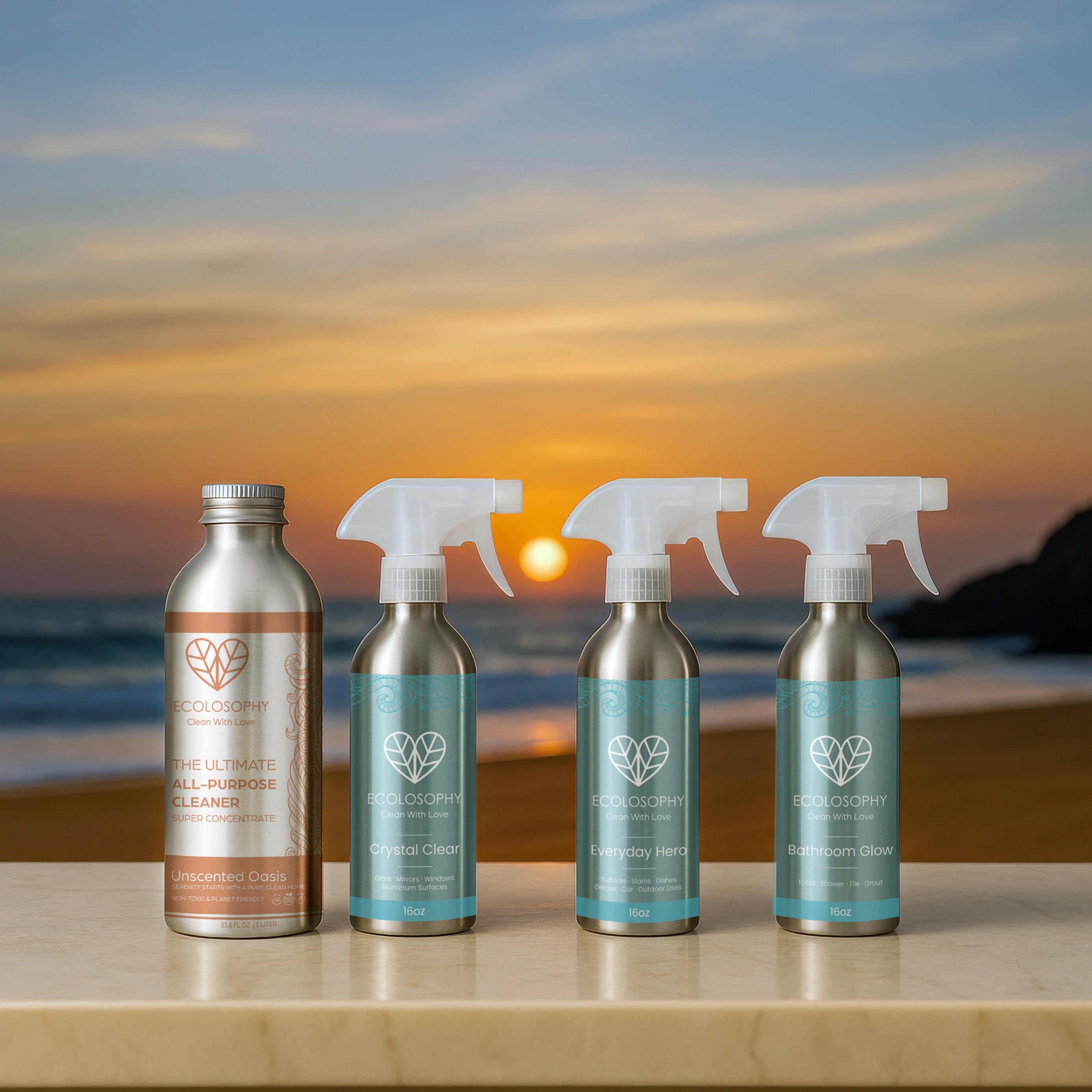
If you want to see exactly what we put in our concentrate — full ingredient list, nothing hidden — the Unscented Oasis concentrate is the one I reach for first: no scent, no quats, no synthetic fragrance. Small-batch, made with care. You can compare the whole lineup here.
For a deeper look at quats specifically: What Are Quats in Cleaning Products? And if the wider health-and-toxins connection interests you, I keep writing about it on The Detox Journal.
Sources cited
- Crohn's & Colitis Foundation — Overview of Crohn's Disease — Crohn's & Colitis Foundation clinical overview
- Lopez VA et al. (2024), Toxicological Sciences — Oral exposure to benzalkonium chlorides in male and female mice reveals alteration of the gut microbiome — Peer-reviewed animal study of benzalkonium chloride and gut microbiome composition (oral dosing in mice, not human household use)
- Glassner KL et al. (2020), J Allergy Clin Immunol — The microbiome and inflammatory bowel disease — Peer-reviewed review of the microbiome's role in inflammatory bowel disease