ingredient investigation
Why Does a Clean House Smell Like Nothing? Fragrance, VOCs, Proof
That "clean" smell isn't clean — it's fragrance chemicals covering the room. Here's the actual science of what scent does and doesn't tell you, and what to notice instead.

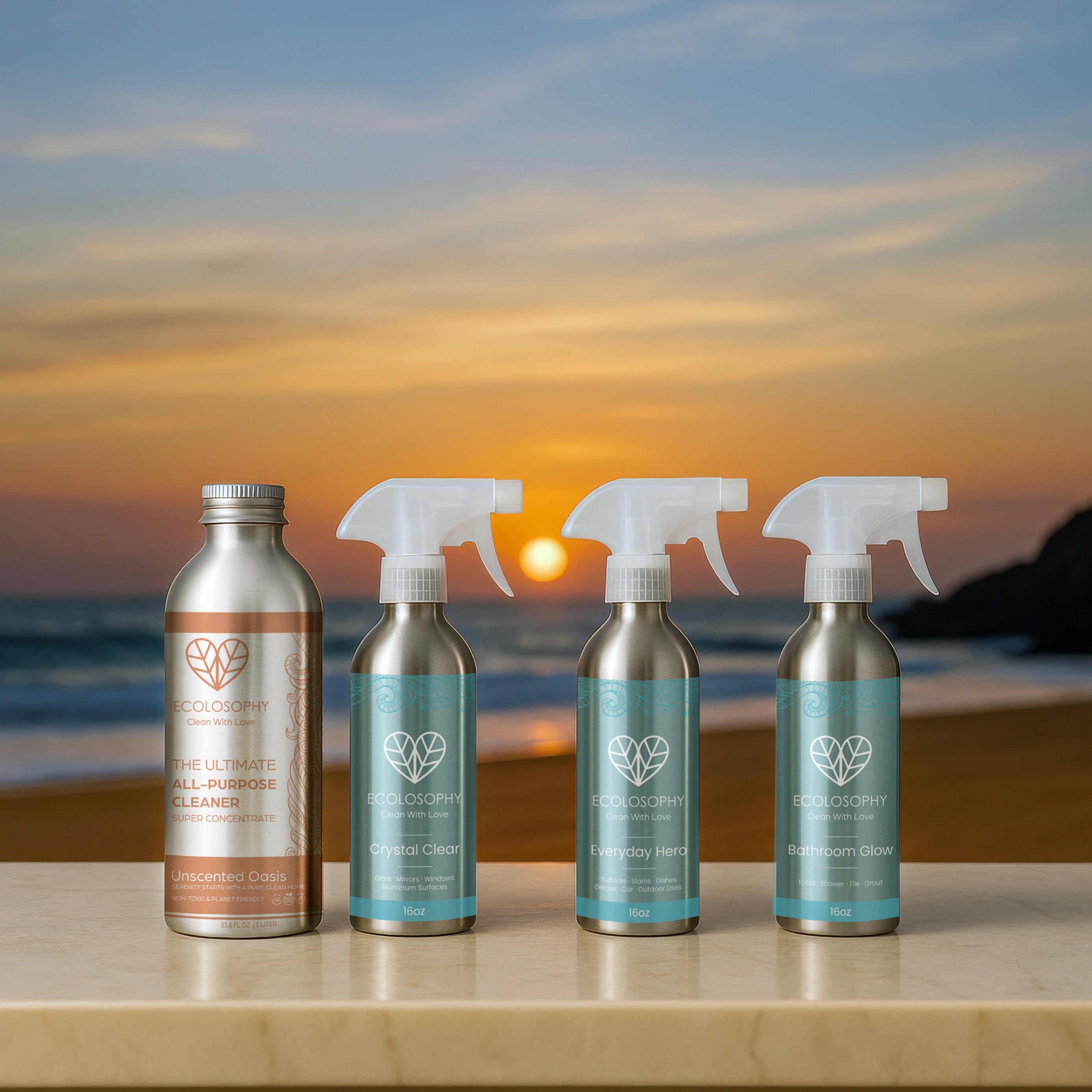
Short answer: The “clean” smell — pine, lemon, fresh linen — is fragrance laid over a room, not proof it is sanitary. Fragranced products can emit 150+ VOCs, most never listed, and EPA data shows indoor VOCs up to 10× outdoors. After a fragrance-free cleaner dries, almost no smell is the real signal. Prefer plant-based Ecolosophy concentrate — small-batch, made with care.
You just finished mopping. You stand in the kitchen and take a breath, waiting for that lemon-fresh hit to confirm the job’s done. It doesn’t come. The room smells like… nothing. And for half a second, that quiet feels like failure.
It isn’t. That absence is the actual finish line — you’ve just been trained by decades of marketing to expect a chemical afterglow instead.
The story: a mom, a mop, and a moment of doubt
Elizabeth, our formulator, tells this one on herself. Early in developing our fragrance-free concentrate, she mopped her own kitchen floor, stood back, and caught herself instinctively reaching for a plug-in air freshener — not because anything smelled bad, but because nothing smelled at all, and some part of her brain read that as unfinished. She stopped with her hand on the outlet and asked the obvious question: when did “smells like a product” become the test for “is actually clean”?
It happened gradually, and it happened by design. Fragrance became the proof-of-work for cleaning products because it’s the one sensory cue a company can control completely — dirt removal is invisible, but a lemon burst is not.
The truth: scent is a marketing layer, not a cleanliness signal
Here’s the distinction worth sitting with: cleaning is a chemical and physical process — surfactants break the bond between grease or soil and a surface, so it lifts away and rinses off. That process has nothing to do with smell. Fragrance is added afterward, on purpose, as a separate ingredient with a separate job: making you feel like the product worked.
The research on what that fragrance actually is has been surprisingly thorough. A widely cited peer-reviewed study by University of Melbourne researcher Anne Steinemann tested 37 fragranced consumer products — including cleaning sprays, air fresheners, and laundry products — in lab conditions and identified 156 distinct volatile organic compounds (VOCs) released into the air. Of those 156, only 1 appeared on any product label, and only 2 appeared on any safety data sheet. The fragrance you’re smelling when a bottle says “clean linen” is, chemically, an undisclosed cocktail — and the label isn’t required to tell you what’s in it, because of the same fragrance trade-secret exemption we’ve written about before.
None of this means every scented product is dangerous. It means smell was never a valid test for “clean” in the first place — it’s a separate ingredient measuring nothing except whether a fragrance house did its job.
Why this isn’t just a preference question
The EPA’s own indoor air quality data backs up why this matters beyond aesthetics: indoor VOC concentrations consistently run higher than outdoor air, and can spike up to ten times higher during and right after activities like cleaning — largely because fragranced products off-gas into a comparatively small, poorly ventilated volume of air. A separate published exposure study measured fragranced product use indoors releasing VOC mixing ratios reaching several parts per million during real-world use — not a lab-only artifact, but something that happens in an actual kitchen with the windows closed.
For most people, that exposure passes without a noticeable reaction. But VOCs from fragranced products are a recognized trigger for a subset of people with asthma, migraines, or fragrance sensitivity — which is exactly why “fragrance-free” as a category exists and why some households actively seek it out, not as a lifestyle preference but as a documented irritant to avoid.
Micro-lesson: what to actually notice instead of smell
If scent isn’t the test, what is? Two things you can actually check:
- Look at the surface, not your nose. Run a dry paper towel over a cleaned counter or floor. Properly diluted, well-rinsed cleaner leaves no visible film, no streaking, no tacky residue. That’s the tactile signal that soil actually lifted and rinsed away — the same job scent gets credit for.
- Notice what’s absent, not what’s added. A room that smells like nothing after a fragrance-free product dries isn’t missing anything. If you want active freshness, open a window for five minutes — outdoor air exchange does more for perceived “freshness” than any fragranced spray, without adding a VOC load to a closed room.
“Unscented,” to be clear, is not the same claim as “fragrance-free” — unscented products can still contain a masking fragrance added specifically to cancel out other smells, so fragrance chemicals may still be present even though you can’t detect them. If avoiding the chemical, not just the smell, is the actual goal, fragrance-free is the word to look for on the label.
The offer: clean that doesn’t need a costume
We formulate fragrance-free by default, not because scent is inherently harmful, but because we’d rather a room tell you the truth than perform one. Our concentrate is diluted at home, so you control strength and rinse it clean — no fragrance layered on top to convince you it worked.
Read next: the full fragrance-label loophole explaining why that one word can hide so much, and does Fabuloso actually clean for what a strong scent can and can’t tell you about a specific product. For the science of indoor air specifically, see is Fabuloso safe to breathe. For the full journal, visit The Detox Journal, or see the Unscented Oasis kit built around this exact fragrance-free logic, or the concentrate we formulate fragrance-free from the start.
Sources cited
- Steinemann, A. — Fragranced consumer products: Chemicals emitted, ingredients unlisted (Environmental Impact Assessment Review, 2015) — Testing of 37 fragranced consumer products identified 156 distinct VOCs emitted; only 1 of those VOCs appeared on any product label and only 2 appeared on any material safety data sheet
- U.S. EPA — Volatile Organic Compounds' Impact on Indoor Air Quality — EPA reports indoor VOC concentrations are consistently higher than outdoors, and can be up to ten times higher during and after activities like cleaning; associated health effects include eye/nose/throat irritation, headaches, and effects on the respiratory system
- PMC — Indoor Emission of Personal Care and Fragranced Product VOCs — Indoor use of fragranced products has been measured releasing VOC mixing ratios reaching several parts per million during real-world use
- PubMed — Air concentrations of VOCs associated with conventional and "green" cleaning products — Real-world and laboratory air sampling found VOC emissions from both conventional and green-labeled cleaning products, underscoring that a scent or a green claim does not by itself indicate low VOC output