
How to Clean Your Whole Home With Just Water and One Concentrate
Open the cabinet under your sink. Count the bottles. There's a kitchen spray, a glass spray, a bathroom spray, a floor cleaner, a "multi-surface" spray that overlaps all of them — and most are 90-plus percent water you paid to ship across the country in plastic. Here's how to replace that whole shelf with one small bottle, some tap water, and a refillable spray bottle you already own.
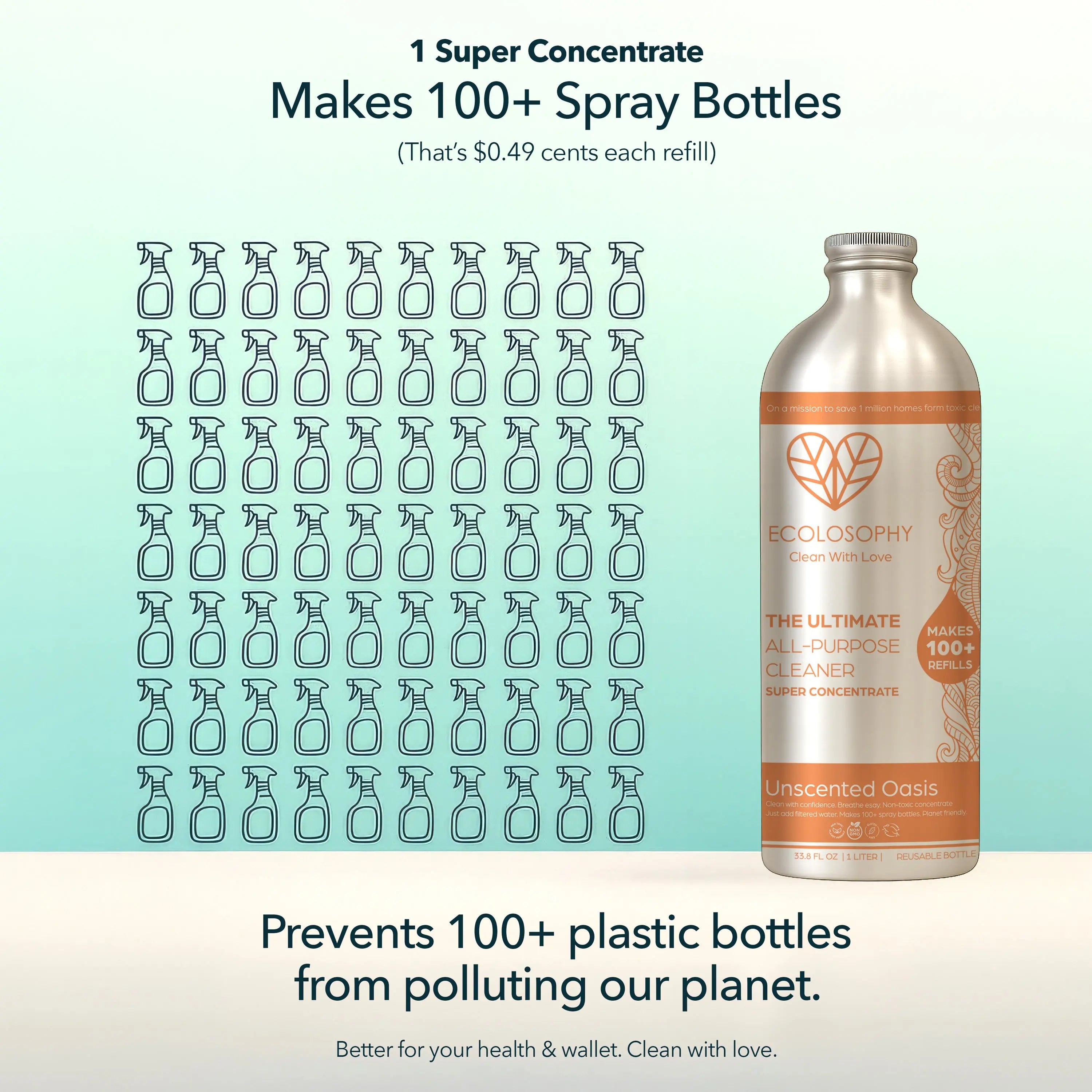
Short answer: Add a measured amount of plant-based concentrate to a refillable bottle, top with water, and adjust strength by job — lighter for glass, standard for counters, stronger for grease. One Ecolosophy concentrate — fragrance-free options, small-batch, made with care — makes 100+ spray bottles for nearly every room.
Why one concentrate can replace a whole cabinet
Here's the part the cleaning aisle would rather you not think about: most of what you buy in a ready-to-use spray bottle is water. A typical all-purpose spray is mostly water with a small fraction of active ingredients — the surfactants that actually lift dirt, plus whatever scent and preservatives the brand added. You are paying retail prices, and a heavy environmental cost, to truck pre-diluted water around the country in single-use plastic.
A concentrate flips that. Instead of shipping the water, you ship only the working ingredients in a small bottle, then add the water yourself at home — straight from your tap, for free. That one change is why a single bottle can stretch into 100+ spray bottles' worth of cleaner. It's the same reason concentrated coffee or frozen juice goes further: you're not paying to move water that was already in your kitchen.
The second reason one product can do so many jobs is that most everyday household messes are variations of the same thing — dust, food residue, body oils, grease, soap scum, and general grime. They don't each require a different chemistry. They require a good plant-based surfactant and the right amount of it. So rather than buying a separate "kitchen," "glass," "bathroom," and "floor" formula — which are often nearly identical liquids in differently-shaped bottles — you keep one concentrate and simply change how much water you add. Strength, not a different chemical, is what matches the cleaner to the job.
What you need to get started
This is intentionally low-tech. You almost certainly own most of it already:
- One bottle of concentrate. The Ecolosophy Pure Serenity Kit is plant-based, with no artificial scents — plant-based and fully disclosed — just add water.
- Refillable spray bottles. Reuse the empties you already have, or keep two or three labeled bottles so you can mix different strengths. Glass or sturdy reusable plastic both work.
- A bucket for floors, and a couple of microfiber cloths or a reusable mop pad. Microfiber does most of the heavy lifting on glass and stainless because it lifts residue rather than smearing it.
- Plain tap water. That's the whole second ingredient. If your tap water is very hard, you'll just nudge the concentrate up slightly.
Label your bottles so nobody has to guess what's inside — a piece of tape and a marker is plenty. Keep all cleaning products, concentrate included, sealed and out of reach of children and pets. Concentrate is potent before you dilute it; treat the small bottle with the same care you'd give any cleaner.
The dilution ratios: matching strength to the job
This is the core of the whole method. You're not memorizing chemistry — you're choosing one of three strengths. Always pour the concentrate into the bottle first, then add water on top; that keeps it from foaming over and mixes it evenly. Read the directions on your specific bottle and use them as the source of truth — the ranges below are a practical starting framework you can adjust to your water and your messes.
| Strength | Best for | How it should feel |
|---|---|---|
| Light (most water) | Glass, mirrors, quick dusting wipe-downs, finished wood, electronics-adjacent surfaces, daily "tidy" sprays | Barely slick. Should dry fast and clear with no film. |
| Standard (everyday mix) | Kitchen counters, tables, cabinet fronts, painted walls, bathroom sinks, most floors, general all-purpose use | Lightly slippery when rubbed between fingers. This is your default bottle. |
| Strong (least water) | Stovetops and range hoods, greasy backsplashes, oven exteriors, garbage bins, baseboards, set-in grime and soap scum | Noticeably soapy. Let it dwell a minute on grease before wiping. |
Two rules make this foolproof. First, start lighter than you think. It's faster to add a splash more concentrate to a too-weak bottle than to deal with streaks from a too-strong one. Second, let it dwell on tough jobs. Grease and dried-on food give up far more easily if the cleaner sits on them for thirty to sixty seconds before you wipe — that pause does more than scrubbing harder. For glass especially, a lighter mix plus a dry microfiber buff is the streak-free secret; over-concentrated cleaner is the usual cause of streaks people blame on the cleaner itself.
Room by room, with one bottle and water
Kitchen
Use your standard mix for counters, the table, the front of cabinets, the fridge door, and the sink. Spray, give it a few seconds, wipe with a damp microfiber cloth. For the stovetop, range hood, and any greasy backsplash, switch to the strong mix, let it dwell while you do something else, then wipe — the grease lifts instead of smearing. A quick note on what a cleaner is and isn't: an all-purpose cleaner removes dirt, grease, and grime, which is exactly what most kitchen surfaces need day to day. It is a cleaner, not an EPA-registered disinfectant, so for sanitizing after raw meat, follow safe-food-handling guidance.
Bathroom
Standard mix handles the sink, counter, toilet exterior, and chrome fixtures. For soap scum on tubs and tile, reach for the strong mix, let it sit, then wipe or lightly scrub. Mirrors get the light mix and a dry buff so they finish clear. One bottle does the entire room, which means there's no longer a graveyard of half-used bathroom-specific sprays under the sink — see our full non-toxic bathroom cleaner guide if you want the room broken down surface by surface.
Floors
Add a small amount of concentrate to a bucket of warm water — think standard-to-strong depending on how dirty the floor is and what it's made of — then mop as usual. Because you control the dose, you can go gentle on sealed wood and a touch stronger on entryway tile that takes the brunt of shoes and paws. Wring the mop well; a damp mop cleans better than a soaking one and dries faster.
Glass, mirrors, and stainless
This is where the light mix shines. Mist the surface, wipe with one microfiber cloth, then immediately buff dry with a second clean, dry cloth. The dry buff is what eliminates streaks. On stainless steel, finish your wipe in the direction of the grain.
The rest of the house
Standard mix covers painted walls, baseboards (go strong if they're scuffed), light switches, door handles, trash-can lids, and general dusting when you spritz a cloth lightly. Anywhere a baby crawls or a pet lounges, you can refill and wipe as often as you want — which is the quiet superpower of a concentrate. When cost stops being a reason to skip a wipe-down, the high-touch surfaces in your home simply get cleaned more often.
Want the room-by-room version of this?
The free 7-Day Home Detox walks you through one room a day — what to toss, what to keep, what actually matters.
The cost and plastic math
Here's the part that makes the switch feel obvious once you see it laid out. The kit runs $49.95-$65, and a single bottle of concentrate makes 100+ spray bottles of finished cleaner. Compare that to buying a hundred-plus ready-to-use sprays one at a time: dozens of plastic bottles, dozens of trips to restock, and a cabinet that's perpetually cluttered.
| What you're comparing | A cabinet of pre-mixed sprays | One Ecolosophy concentrate |
|---|---|---|
| What you're shipping & storing | Mostly water, in many plastic bottles | Active ingredients only; you add water at home |
| Bottles to buy | Dozens of single-use bottles over time | One bottle that refills 100+ spray bottles |
| Number of products | A separate formula per room or surface | One concentrate, three strengths |
| Carbon footprint | Repeated manufacturing & shipping of water | Roughly 42.75 lbs CO2 saved per bottle |
The plastic savings are the headline most people feel good about — every refill is a bottle that never gets made, shipped, or tossed. But the daily win is quieter: one product you can fully read, family-safe and pet-safe, plant-based, with no artificial scents — plant-based and fully disclosed, that you actually reach for more often because it's right there and it's affordable to use.
Frequently asked questions
Do I really only need one product for the whole house?
For everyday cleaning — dirt, grease, food residue, body oils, soap scum, and general grime — yes, one all-purpose concentrate at the right strength covers the great majority of surfaces. The exceptions are specialty tasks like disinfecting (an all-purpose cleaner is a cleaner, not an EPA-registered disinfectant) and a few delicate materials with their own care rules, such as natural stone, where you'd follow the manufacturer's guidance.
How much concentrate goes in each bottle?
Follow the dilution directions printed on your specific bottle as the source of truth, then adjust by strength: less concentrate for a light glass mix, your everyday amount for a standard all-purpose mix, and more for a strong degreasing mix. Start on the lighter side and add a little more if a job needs it — and if the label itself confuses you, our guide to reading a cleaning product label walks through every line.
Can I just use water alone?
Plain water and a good microfiber cloth handle light dust and quick smudges surprisingly well, which is part of why microfiber is so useful here. But water alone won't lift grease, oils, or sticky food residue — that's what the surfactants in the concentrate are for. The method is water plus a measured bit of concentrate, scaled to the mess.
Will a fragrance-free cleaner actually clean as well?
Yes. Scent is added for marketing, not cleaning power — the real work is done by surfactants, not perfume. The Ecolosophy concentrate has no artificial scents — plant-based and fully disclosed and still cuts everyday dirt, grease, and grime. A home that simply smells like nothing is often the cleanest sign of all.
Is it safe around kids and pets?
The finished, diluted cleaner is plant-based, family-safe, and pet-safe, with no artificial scents — plant-based and fully disclosed — which is exactly why people feel comfortable using it on the floors their kids crawl on and their pets walk across. As with any cleaner, store the concentrated bottle sealed and out of reach, keep little hands out of mop buckets, and let surfaces dry.
How long does one bottle actually last?
Because one bottle makes 100+ spray bottles of finished cleaner, most households go a remarkably long time between repurchases. The exact stretch depends on how much you clean, but the whole point is that cost per spray drops low enough that you stop rationing it.
📕 Free download · 28 pages
Not ready to switch yet? Get the free playbook.
28 pages, every non-toxic swap, room by room. One email, no spam.
We'll email it from hello@ecolosophy.com. Reply anytime — a real person answers.
Sent. Check your inbox.
The download link is heading to your email. If you don't see it in 2 minutes, look in Promotions or hit resend.
Or grab it right now: Download the 28-page PDF →
Couldn't deliver — try again? Retry
← Back to the full Non-Toxic Cleaning Guide
Keep Reading
Unscented Oasis Kit
$69 · 4.97★ · 72 reviews