
Are Toilet Bowl Cleaners Toxic?
That blue gel and its sharp chemical bite live in a small, badly ventilated room your whole family uses every day. Let's read what's actually in conventional bowl cleaners, why the fumes and mixing warnings are serious, and how to keep a bowl spotless without the harsh stuff.
Short answer: Many toilet bowl cleaners use strong acids or bleach that irritate lungs and burn skin on contact. Flag fumes, splash, and never mixing with other products. Prefer ventilation and a plant-based, fragrance-free Ecolosophy concentrate for routine bathroom wipe-downs — small-batch, made with care.
What's actually in a conventional toilet bowl cleaner?
Toilet bowl cleaners are formulated to do three aggressive jobs at once: dissolve hard-water and mineral scale, kill or claim to kill germs, and leave a strong "clean" smell behind. To hit all three cheaply, most rely on a small set of harsh actives — and the exact mix depends on whether you bought a "bleach" formula, an "acid" formula, or a "disinfecting" one. Rather than guess what's in a specific bottle (formulas change, and the lineup varies), it's more useful to understand the ingredient classes people ask about and then read the current label or the manufacturer's safety data sheet for the bottle in your hand.
Here's the honest truth: the bathroom is the worst room to use the harshest products in. It's small, it's often the least-ventilated space in the house, and it's used by everyone — including the toddler who grabs the rim and the dog who drinks from the bowl. "Smells clean," "is clean," and "is safe to breathe in a closed room while you scrub" are three different questions. Let's take the big three ingredient classes one at a time.
Bleach (sodium hypochlorite): the fume and mixing problem
Many bowl cleaners — especially the thick, clinging gels marketed as disinfecting — are built around sodium hypochlorite, the same active in chlorine bleach. It's effective at whitening and killing germs, which is exactly why it's everywhere. But it comes with real downsides in a small bathroom:
- Respiratory irritation: bleach gives off chlorine-type fumes, and those fumes concentrate fast in a closed bathroom. Per agencies like the CDC, the gas can irritate the eyes, nose, throat, and lungs — and people with asthma are more sensitive. Infant airways are smaller and still developing, so a smell that's merely "strong" to you can be genuinely irritating to them.
- Skin and eye contact: splashes while scrubbing under the rim can sting skin and burn eyes. A drip onto bare hands is an everyday occurrence with these products.
- The mixing danger: this is the big one. Combining a bleach-based cleaner with an acid-based one — or with ammonia, or with certain other bowl cleaners — can release toxic gases. People do this accidentally all the time by using two products back-to-back in the same bowl. We'll come back to this, because it's the single most important safety rule in the whole bathroom.
Hydrochloric acid and other strong acids: the scale-busters
The cleaners that promise to blast away stubborn rings, rust stains, and hard-water scale often do it with hydrochloric acid (HCl), sometimes labeled muriatic acid, or with other strong acids like sulfuric or phosphoric. Acid dissolves mineral deposits fast, which is why these formulas feel almost instant on a crusty bowl. The trade-off is that the same chemistry that eats limescale is rough on you:
- Corrosive to skin and eyes: strong acids can cause chemical burns on contact. A splash to the eye is a medical emergency. These are not products you want to use casually, one-handed, while distracted by a kid in the next room — and no, rubbing alcohol isn't a safe substitute for descaling a bowl either; different job, different risks.
- Irritating vapors: acid cleaners can off-gas in an enclosed bathroom, irritating the nose, throat, and lungs as you lean over the bowl to scrub.
- The mixing rule applies double: mixing an acid bowl cleaner with a bleach bowl cleaner is exactly the combination that releases toxic chlorine gas. Because both are sold as "toilet bowl cleaner," it's frighteningly easy to grab the wrong second bottle.
None of this means a careful adult can't use these safely — gloves, ventilation, one product at a time, never mixing. It means the margin for error is small, and bathrooms are where margins get thin: rushed, distracted, sharing the space with people who can't read a warning label.
Quats (quaternary ammonium compounds): the "disinfecting" actives
Many bowl cleaners that advertise killing germs use quaternary ammonium compounds — "quats" — such as benzalkonium chloride. They're common disinfectant actives across household cleaning. The honest, balanced picture:
- Respiratory sensitization: quats are recognized irritants and skin sensitizers, and case reports in the occupational literature have documented work-related asthma in staff repeatedly handling benzalkonium chloride disinfectants. Cleaning workers who use them daily are the most-studied group.
- Residue: disinfectant actives are designed to linger on a surface, which is the point — but it also means residue stays where curious hands and paws reach.
- Context matters: for an occasional careful clean in a ventilated room, exposure is low. The concerns scale with how often, how concentrated, and how poorly-ventilated the use is.
Worth saying plainly: a routine toilet does not usually need a registered disinfectant to be clean. Cleaning — physically removing dirt, scale, and grime — is a different job from disinfecting, and most days the bowl just needs cleaning.
The fume problem is really a small-room problem
A lot of the worry about bowl cleaners isn't about a single villain molecule — it's about where you use them. The bathroom is typically the smallest, most enclosed room in the home, frequently without a window or with a fan that barely runs. You then lean directly over the bowl, face close to the surface, and scrub for a minute or two. That's close-range exposure to whatever the product is giving off, in the worst-ventilated space available.
So even ingredients that are "fine when used as directed" get used in the least-ideal conditions. The fixes for harsh cleaners are real but require discipline every single time: open a window, run the fan, wear gloves, never mix products, rinse well, store sealed and out of a child's or pet's reach. The question worth asking is whether you want a cleaning routine that depends on flawless caution in a cramped room — or one that's forgiving by design.
Toilet bowl cleaner ingredient classes at a glance
| Ingredient class | Why it's used | Common concerns |
|---|---|---|
| Bleach (sodium hypochlorite) | Whitening, disinfecting | Fumes in small rooms; eye/skin irritation; toxic gas if mixed with acids or ammonia |
| Strong acids (HCl, sulfuric, phosphoric) | Dissolving scale, rust, hard-water rings | Corrosive burns; irritating vapors; toxic gas if mixed with bleach |
| Quats (e.g., benzalkonium chloride) | Killing germs, lingering residue | Respiratory and skin sensitization with repeated exposure; residue |
| Synthetic "fragrance" | Masking scent, "smells clean" cue | Undisclosed blend; possible asthma trigger; can shelter phthalates |
| Plant-based surfactants (cleaner, not disinfectant) | Lifting everyday dirt and grime | Far gentler; not an EPA-registered disinfectant |
This is a general map of classes, not a claim about any one branded bottle. For the exact product you own, the label and safety data sheet are the source of truth — and the fact that you sometimes need the safety data sheet to understand a cleaner is itself worth sitting with.
Want the room-by-room version of this?
The free 7-Day Home Detox walks you through one room a day — what to toss, what to keep, what actually matters.
Never mix toilet bowl cleaners — the one rule that matters most
If you remember nothing else: use one product at a time, and never combine cleaners. Mixing a bleach-based cleaner with an acid-based one can release toxic gas, and the same goes for mixing bleach with ammonia. The trap with toilets specifically is that two completely different bottles can both say "toilet bowl cleaner," so people unknowingly use one, then reach for another to "really get it clean." Don't. Pick one product, ventilate the room, let it work, rinse, and put it away. If a bowl needs more than one approach, fully rinse between them — better yet, simplify your cabinet so there's no dangerous second bottle to grab.
A safer routine: clean the bowl without the burn
For an everyday-clean toilet — not a biohazard, just normal household use — you don't need the harshest chemistry on the shelf. A safer routine looks like this:
- Clean regularly, not nuclearly. A quick, frequent scrub with a gentle, plant-based cleaner stops grime and scale from building into the kind of crust that "needs" acid. Consistency beats intensity.
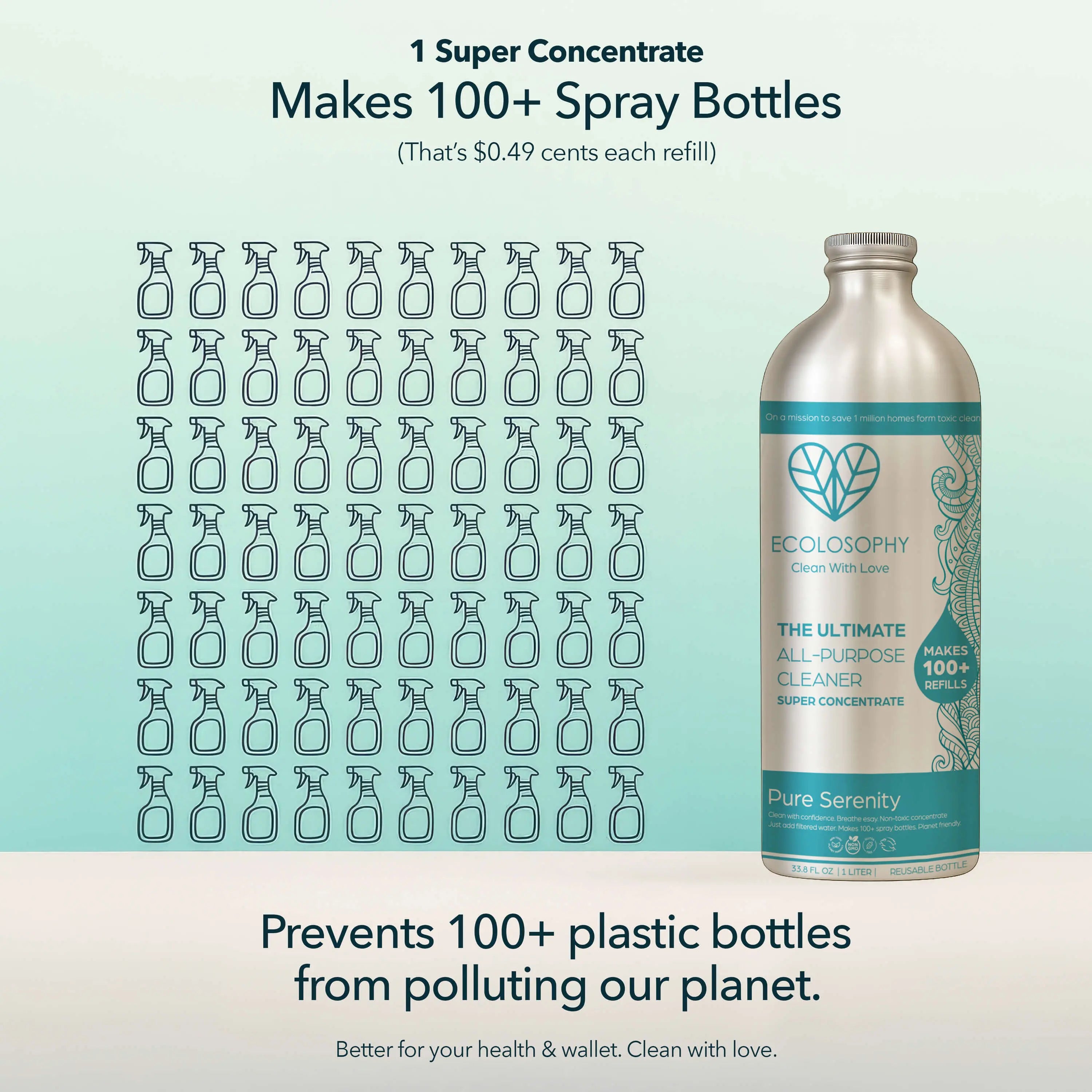
- Use a fragrance-free, plant-based cleaner for the routine. The Ecolosophy Pure Serenity Kit is plant-based, with no artificial scents — plant-based formula — family-safe, pet-safe, and planet-safe. It cuts everyday dirt and grime on the bowl, the seat, and the rest of the bathroom — see our full non-toxic bathroom cleaner routine for the sink, tub, and tile too. It's a cleaner, not an EPA-registered disinfectant, so for true disinfection follow public-health guidance and a registered product's directions.
- One bottle, the whole bathroom. Because it's a concentrate, you just add water — one Ecolosophy bottle makes 100+ spray bottles, so you can refill and wipe the high-touch areas as often as you like without thinking about cost. That also means one simple, readable product in the cabinet instead of a row of harsh ones you have to keep from mixing.
- Lighter on the planet, too. Concentrate format saves roughly 42.75 lbs of CO2 per bottle versus buying dozens of single-use plastic cleaners — fewer bottles made, shipped, and tossed.
None of this is about fear. It's about choosing a routine that's forgiving by design — readable ingredients, no fumes to dread, nothing dangerous to accidentally mix — in the one small room where caution is hardest to maintain.
Frequently asked questions
Are toilet bowl cleaners toxic to humans?
Used as directed — ventilated, never mixed with another cleaner, with gloves for the acid types, and stored sealed — a healthy adult generally tolerates conventional bowl cleaners. The real-world hazards are fumes building up in a small bathroom, splashes to skin and eyes, accidental mixing of bleach and acid products, and curious kids or pets reaching the bowl. For the exact risks of a specific bottle, check its current label or safety data sheet.
What's the danger of mixing toilet bowl cleaners?
Mixing a bleach-based cleaner with an acid-based one, or bleach with ammonia, can release toxic gases. Because two different products can both be labeled "toilet bowl cleaner," people mix them by accident. The rule is simple: one product at a time, good ventilation, rinse between approaches, never combine them.
Are toilet bowl cleaners safe for pets like dogs and cats?
The main danger is a pet drinking from the bowl or a spill, especially right after using a harsh cleaner, since residue and treated water can be in the basin. Keep the lid down, store products sealed and out of reach, rinse well, and never leave concentrated cleaner accessible. A fragrance-free, plant-based cleaner reduces both the residue and the temptation. If a pet ingests cleaner, call your vet or a pet poison-control line.
Do I need bleach to get a toilet truly clean?
For everyday household use, no. Cleaning — physically removing dirt, scale, and grime — is a different job from disinfecting, and most days the bowl just needs cleaning, which a plant-based cleaner handles. If you need to disinfect for a specific reason, follow public-health guidance and the directions on an EPA-registered disinfectant.
Is a fragrance-free, plant-based cleaner strong enough for the bathroom?
Yes, for routine cleaning. The scent in conventional cleaners is added for marketing, not cleaning power — the actual work is done by surfactants. The Ecolosophy All-Purpose Cleaning Concentrate cuts everyday dirt, grease, and grime on the bowl, seat, and surfaces without any added fragrance. It is a cleaner, not an EPA-registered disinfectant.
How does a concentrate help a family bathroom?
You add water to a small bottle of active ingredients, so one Ecolosophy bottle makes 100+ spray bottles. That lets you refill and wipe high-touch areas as often as you like without worrying about cost, keeps a single readable product in the cabinet instead of a row of harsh ones, and saves roughly 42.75 lbs of CO2 per bottle versus dozens of single-use plastic cleaners.
📕 Free download · 28 pages
Not ready to switch yet? Get the free playbook.
28 pages, every non-toxic swap, room by room. One email, no spam.
We'll email it from hello@ecolosophy.com. Reply anytime — a real person answers.
Sent. Check your inbox.
The download link is heading to your email. If you don't see it in 2 minutes, look in Promotions or hit resend.
Or grab it right now: Download the 28-page PDF →
Couldn't deliver — try again? Retry
← Back to the full Non-Toxic Cleaning Guide
Keep Reading
Pure Serenity Kit
$69 · 4.97★ · 72 reviews